Key Takeaways
- Holistic Assessment: Contact lens eligibility depends on eye health (tear film, cornea shape) as much as prescription.
- Dry Eye is Key: Severe dry eye or compromised Meibomian glands may disqualify you from standard soft lenses until managed.
- Advanced Diagnostics: Spectacle PDX uses Meibography (for tear film) and Corneal Topography (for shape) to ensure the safest fit.
- Specialty Lenses: Conditions like keratoconus or high astigmatism often require custom lenses (RGP or Scleral) for optimal vision.
- Safety First: Never reuse solution or sleep in contacts, as this dramatically increases the risk of serious eye infection.
Introduction
Contact lenses offer freedom from frames, a wider field of view, and a convenient solution for many vision problems. But how do you know if this solution is right for you? Before you start dreaming of life without glasses, it’s crucial to determine your contact lens eligibility with a thorough professional assessment.
In the Portland/Beaverton community, Spectacle PDX is dedicated to ensuring not only that your contacts fit perfectly, but that they are the safest and healthiest choice for your eyes. We use advanced diagnostic tools to analyze your eye health, tear film, and corneal shape-steps essential to finding out exactly who is a good candidate for contact lenses.
The Evolution of Eye Care: Beyond the Basics
Assessing contact lens candidacy starts with a detailed eye health check. Our approach to a comprehensive eye exam Portland can trust ensures we have a complete clinical picture before discussing lenses.
We prioritize your comfort and time by utilizing modern technology:
- No Drops, No Blur: We minimize the need for pupil-dilating drops with non-invasive retinal imaging (Optomap), allowing you to leave your comprehensive eye exams Portland with clear vision.
- Gentle Pressure Check: We skip the uncomfortable “air puff” and use modern, gentler methods to check for glaucoma risk.
- Personalized Time: Unlike rushed clinics, our doctors take the necessary time to discuss your lifestyle, health history, and specific visual needs, which is vital when deciding who should not wear contact lenses and why.
Determining Who Is a Good Candidate for Contact Lenses
Ultimately, the best contact lens eligibility assessment comes down to the health of your eye’s surface and your unique anatomy.
The Ideal Candidate
Generally, who is a good candidate for contact lenses? The ideal patient has:
- Stable Vision: A prescription that has not drastically changed in the past year.
- Healthy Corneas: Corneas that are free of significant damage or unusual shape (unless fitted with specialty lenses).
- Sufficient Tear Production: Enough healthy tears to keep the lenses moist and comfortable throughout the day.
- Excellent Hygiene: A commitment to following strict cleaning, disinfection, and wearing schedules.
Advanced Diagnostics: Revealing Surface Health
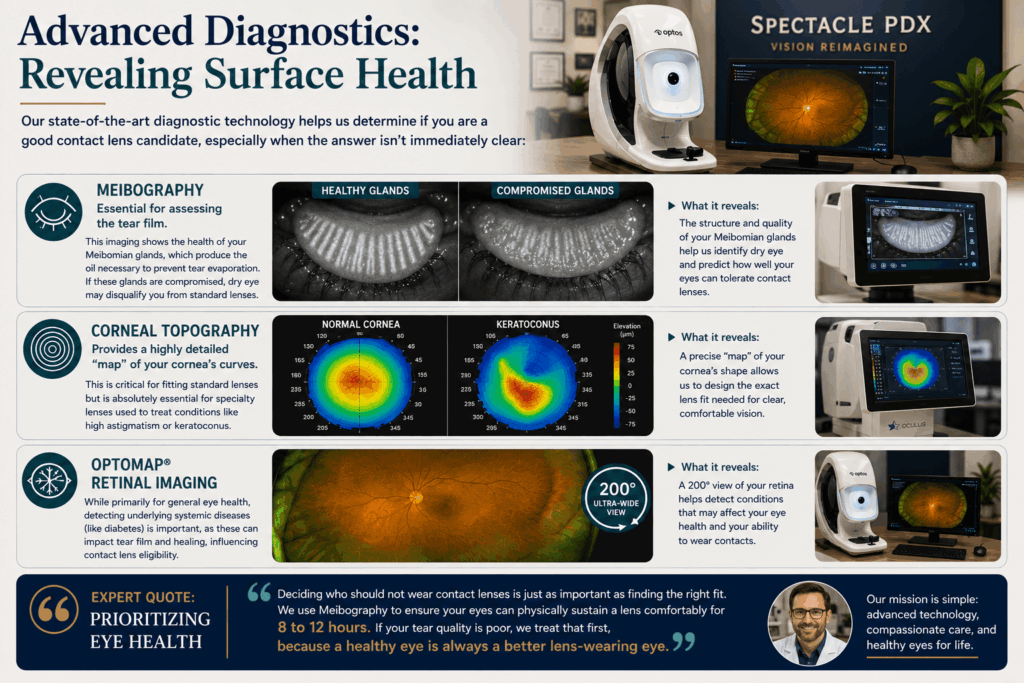
Our state-of-the-art diagnostic technology helps us determine if you are a good contact lens candidate, especially when the answer isn’t immediately clear:
- Meibography: Essential for assessing the tear film. This imaging shows the health of your Meibomian glands, which produce the oil necessary to prevent tear evaporation. If these glands are compromised, dry eye may disqualify you from standard lenses.
- Corneal Topography: Provides a highly detailed “map” of your cornea’s curves. This is critical for fitting standard lenses but is absolutely essential for specialty lenses used to treat conditions like high astigmatism or keratoconus.
- Optomap Retinal Imaging: While primarily for general eye health, detecting underlying systemic diseases (like diabetes) is important, as these can impact tear film and healing, influencing contact lens eligibility.
Expert Quote: Prioritizing Eye Health “Deciding who should not wear contact lenses is just as important as finding the right fit. We use Meibography to ensure your eyes can physically sustain a lens comfortably for 8 to 12 hours. If your tear quality is poor, we treat that first, because a healthy eye is always a better lens-wearing eye.”
Who Should Not Wear Contact Lenses?
While new lens technologies continue to expand the pool of eligible patients, some conditions require careful management or may temporarily or permanently disqualify you:
- Severe Dry Eye: Chronic, severe dry eye treatment Beaverton patients often seek. If the underlying cause cannot be managed, standard soft lenses can worsen discomfort.
- Frequent Eye Infections: Patients with chronic blepharitis or a history of recurring eye infections may pose a higher risk.
- Uncontrolled Allergies: Severe seasonal or environmental allergies can cause intense irritation, making lenses unbearable during peak seasons.
- Poor Hygiene/Compliance: Contact lens wear requires meticulous cleaning and replacement schedules. Patients who struggle with this commitment are at a high risk for serious infections.
Addressing Specific Eye Health Concerns
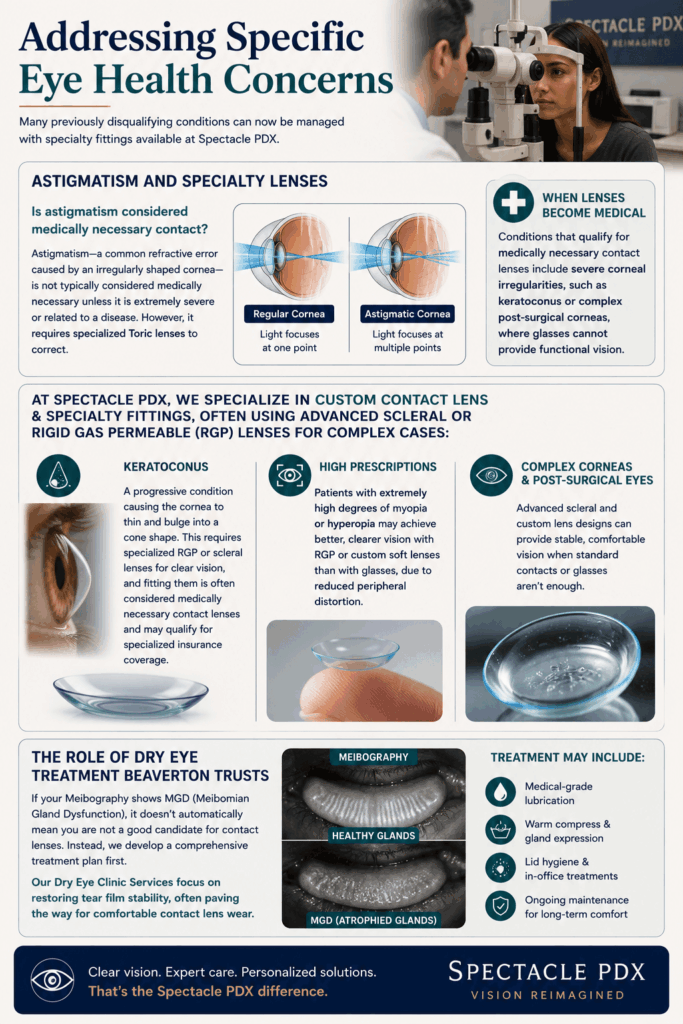
Many previously disqualifying conditions can now be managed with specialty fittings available at Spectacle PDX.
Astigmatism and Specialty Lenses
Is astigmatism considered medically necessary contact? Astigmatism-a common refractive error caused by an irregularly shaped cornea-is not typically considered medically necessary unless it is extremely severe or related to a disease. However, it requires specialized Toric lenses to correct.
Conditions that qualify for medically necessary contact lenses include severe corneal irregularities, such as keratoconus or complex post-surgical corneas, where glasses cannot provide functional vision.
At Spectacle PDX, we specialize in Custom Contact Lens & Specialty Fittings, often using advanced scleral or rigid gas permeable (RGP) lenses for complex cases:
- Keratoconus: A progressive condition causing the cornea to thin and bulge into a cone shape. This requires specialized RGP or scleral lenses for clear vision, and fitting them is often considered medically necessary contact lenses and may qualify for specialized insurance coverage.
- High Prescriptions: Patients with extremely high degrees of myopia or hyperopia may achieve better, clearer vision with RGP or custom soft lenses than with glasses, due to reduced peripheral distortion.
The Role of Dry Eye Treatment Beaverton Trusts
If your Meibography shows MGD (Meibomian Gland Dysfunction), it doesn’t automatically mean you are not a good candidate for contact lenses. Instead, we develop a comprehensive treatment plan first. Our Dry Eye Clinic Services focus on restoring tear film stability, often paving the way for comfortable contact lens wear.
The Eyewear Experience: Clinical Expertise Meets Style
Even the most dedicated contact lens wearer needs a great pair of backup glasses. This is especially true for patients who wear specialty lenses, as they may need to rely on their frames during infections or extended travel.
At Spectacle PDX, we ensure your backup glasses are an equally exceptional reflection of your style and precision.
- Quality Lenses for Backup: We ensure your secondary vision correction uses high-quality lenses (Zeiss, Hoya) to maximize clarity when you are not wearing your contacts.
- Designer Frames Beaverton Cares About: Our boutique offers a curated selection of independent, designer frames Beaverton residents appreciate for their unique style and superior craftsmanship.
Expert Quote: “We always advise our contact lens patients to view their best eyeglasses Portland can offer not just as a backup, but as an essential part of their vision health strategy. The quality of your frame and lens should match the precision of your contact lens fit.” – James Liu, Licensed Optician, Spectacle PDX
Spectacle PDX Services Overview
We combine advanced technology and clinical depth across all our core services in Portland/Beaverton:
- Advanced Comprehensive Exams: Featuring comfortable diagnostics like Optomap and gentle pressure checks.
- Dry Eye Clinic Services: Dedicated diagnosis and customized therapy for improved tear film stability.
- Custom Contact Lens & Specialty Fittings: Expertise in fitting toric, multifocal, RGP, and scleral lenses.
- Designer Eyewear Boutique: A unique, independent selection of frames and premium lens materials.
- Urgent/On-Call Eye Care: Prompt care for any issues related to contact lens wear, including infections or irritation.
Making the Appointment Easy and Convenient
Finding out how I know if my eyes are suitable for contact lenses is simple with Spectacle PDX.
Ready for Your Fit? Our clinic, conveniently located for the Portland/Beaverton area, accepts most major vision and health insurance plans. Scheduling a consultation to determine your contact lens candidacy and receive personalized care is easy-book your comprehensive eye exams Portland residents recommend today!
Tips for Maximizing Your Eye Health
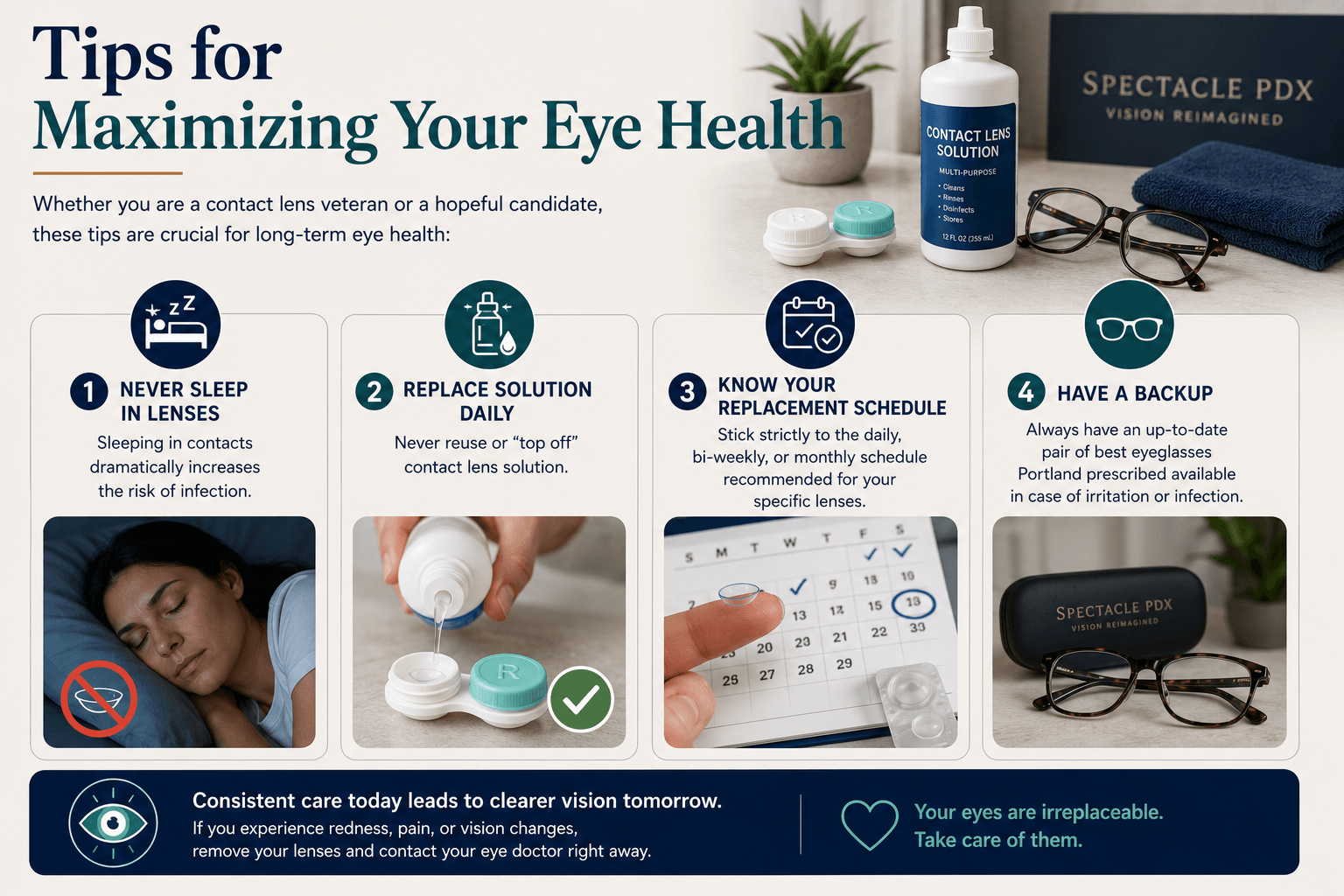
Whether you are a contact lens veteran or a hopeful candidate, these tips are crucial for long-term eye health:
- Never Sleep in Lenses: Sleeping in contacts dramatically increases the risk of infection.
- Replace Solution Daily: Never reuse or “top off” contact lens solution.
- Know Your Replacement Schedule: Stick strictly to the daily, bi-weekly, or monthly schedule recommended for your specific lenses.
- Have a Backup: Always have an up-to-date pair of best eyeglasses Portland prescribed available in case of irritation or infection.
Conclusion
Determining who is a good candidate for contact lenses requires a holistic evaluation of your eye health, anatomy, and lifestyle. While many people are excellent candidates, those with complex prescriptions or underlying conditions like dry eye require the advanced diagnostics and specialty fitting expertise offered by Spectacle PDX.
We offer unparalleled comfort in diagnosis and clinical excellence in fitting specialty lenses. We are your local, independent experts, committed to ensuring the Portland/Beaverton community has access to clinical excellence and personalized, comfortable care.
If you’re looking to assess your contact lens eligibility with the most comprehensive and technologically advanced eye care in the Portland/Beaverton area, book your appointment with Spectacle PDX today.
Frequently Asked Questions
Who should not wear contact lenses?
Individuals with severe, unmanaged dry eye, chronic eye infections, poorly controlled severe allergies, or those who cannot commit to meticulous hygiene and replacement schedules are often not a good candidate for contact lenses. An exam at Spectacle PDX will thoroughly assess these risk factors before fitting.
What disqualifies you from getting contact lenses? When should you not wear contact lenses?
Active eye infections, severe inflammation, or significant unmanaged dry eye disease generally disqualify you from wearing lenses. You should not wear contact lenses during periods of acute illness, high seasonal allergies, or if you experience redness, pain, or irritation, and should revert to your backup glasses immediately.
Is astigmatism considered medically necessary contact? What qualifies for medically necessary contact lenses?
Astigmatism is not typically considered medically necessary unless it is very high or irregular. Conditions that qualify for medically necessary contact lenses usually involve complex corneal irregularities, such as keratoconus, post-surgical corneas, or severe differences in prescription between the two eyes (anisometropia).
How do I know if my eyes are suitable for contact lenses?
The only way to definitively know if your eyes are suitable for contact lenses is through a comprehensive consultation and fitting appointment with an optometrist. Spectacle PDX uses advanced diagnostics like Meibography and corneal topography to analyze your tear film stability and corneal shape, confirming your contact lens eligibility.
Who is considered a good candidate for contact lenses?
An ideal candidate is someone with stable vision (a prescription that has not drastically shifted over the past year), healthy corneas free from significant scarring, and sufficient baseline tear production. Additionally, a strong commitment to meticulous daily hygiene and following strict cleaning, disinfection, and wearing schedules is required.
What are the most critical safety rules for maintaining healthy contact lens wear?
To safeguard your vision, you must never sleep or nap in your contact lenses, as doing so cuts off oxygen to the cornea and dramatically increases your risk of serious eye infections. Additionally, always replace your contact lens disinfecting solution daily—never “top off” or reuse old solution—and strictly adhere to the designated daily, bi-weekly, or monthly replacement schedule for your specific lenses.
Why is having a high-quality pair of backup eyeglasses essential for contact lens wearers?
Every contact lens wearer needs an up-to-date pair of backup glasses. If you develop a sudden eye infection, catch a cold, experience seasonal allergy flare-ups, or travel on a long-haul flight, your eyes require an extended break from contacts. Spectacle PDX pairs your exact prescription with premium lenses from Zeiss or Hoya and independent designer frames to ensure your backup vision is just as clear and stylish as your primary correction.
Can I still wear contact lenses if I suffer from chronic dry eyes?
Yes, depending on the severity and root cause of your condition. While unmanaged dry eye can cause standard soft contacts to feel gritty and unbearable, Spectacle PDX features specialized Dry Eye Clinic Services. By using advanced diagnostics to build a tear film restoration plan first, we can often transition patients comfortably into daily disposable or specialty moisture-retaining scleral lenses.
What types of specialty lenses are available for complex or irregular corneas?
For patients disqualified from wearing standard soft lenses due to corneal irregularities or high astigmatism, Spectacle PDX specializes in custom specialty fittings. These include Rigid Gas Permeable (RGP) lenses and large-diameter Scleral lenses, which vault completely over the sensitive cornea to provide a perfectly smooth, fluid-filled optical surface.
What eye conditions qualify for medically necessary contact lenses?
Medically necessary contact lenses are typically prescribed for complex corneal irregularities where traditional eyeglasses cannot physically provide functional vision. This includes progressive structural conditions like keratoconus (where the cornea thins and bulges into a cone shape), severe corneal scarring, or complex post-surgical corneas.