
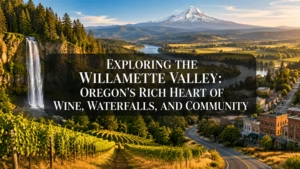
There is a legendary bounty in the Willamette Valley that has drawn people to its rolling landscapes for generations. Stretching roughly 150 miles from the Columbia River in Portland all the way south to Eugene, this expansive, fertile basin is bounded by the rugged Oregon Coast Range to the west and the snow-capped peaks of the Cascade Mountains to the east.
Originally dubbed the “promised land of flowing milk and honey” by 19th-century pioneers tracking along the Oregon Trail, the valley functions as the true cultural, political, and agricultural heart of Oregon. Today, it houses roughly 70 percent of the state’s population while maintaining a remarkably open, rural, and scenic environment where farm-to-table living isn’t just a trend it’s a daily way of life.
About the Region: A Tapestry of Towns and Terroir
The geography of the Willamette Valley is a product of ancient history. Megafloods from the last Ice Age rushed down the Columbia River Gorge and backfilled into the valley, depositing deep, mineral-rich volcanic and marine soils. This unique geography created one of the most productive agricultural regions in North America.
Rather than being one homogenous space, the valley is a collection of distinct communities and micro-regions loosely grouped along the winding path of the Willamette River:
- The Northern Valley (Yamhill, Washington, and Clackamas Counties): Sitting just outside the Portland metro area, this region includes historic towns like Newberg, Dundee, and McMinnville. It is world-renowned as Oregon Wine Country, featuring a high concentration of estate vineyards rolling across the Chehalem Mountains and the Dundee Hills.
- The Mid-Valley (Marion and Linn Counties): Anchored by Salem, the state capital, this area is the epicenter of Oregon’s agricultural industry. The flat, alluvial plains here produce the vast majority of North America’s hazelnuts, turf grass, berries, and hops.
- The Southern Valley (Benton and Lane Counties): Home to university towns like Corvallis (Oregon State University) and Eugene (University of Oregon). This region features a distinct, independent community vibe where tech innovation, collegiate sports, and rugged outdoor recreation seamlessly blend.
The local climate follows a distinct Mediterranean pattern that locals love. Winters are mild, misty, and gray, while the summers are spectacular bringing long, sun-drenched afternoons in the 80s with virtually zero humidity and cool, crisp evening breezes.
Local Attractions and Vibrant Small Towns
Whether you are looking to spend a weekend tasting vintage wines or hiking beneath massive old-growth canopies, the Willamette Valley offers an array of local landmarks.
World-Class Wine Country
For wine lovers, the Willamette Valley is synonymous with world-class Pinot Noir. With more than 700 wineries tucked into 11 distinct micro-appellations (known as AVAs), the area rivals the finest growing regions in France. Unlike corporate commercialized wine regions, most spots here are intimate, family-run vineyards where you can talk directly to the winemakers while looking out over the vines.
State Parks and Waterfalls
Nature is deeply woven into the local lifestyle. The crown jewel of the valley’s park system is Silver Falls State Park near Silverton. Known as the “Trail of Ten Falls,” this pristine state park features a stunning canyon trail where hikers can walk behind multiple roaring waterfalls cascading over ancient basalt cliffs. For water enthusiasts, the Willamette River Greenway offers endless miles of flat-water paddling, kayaking, and seasonal salmon fishing.
Seasonal Changes and Local Lifestyle
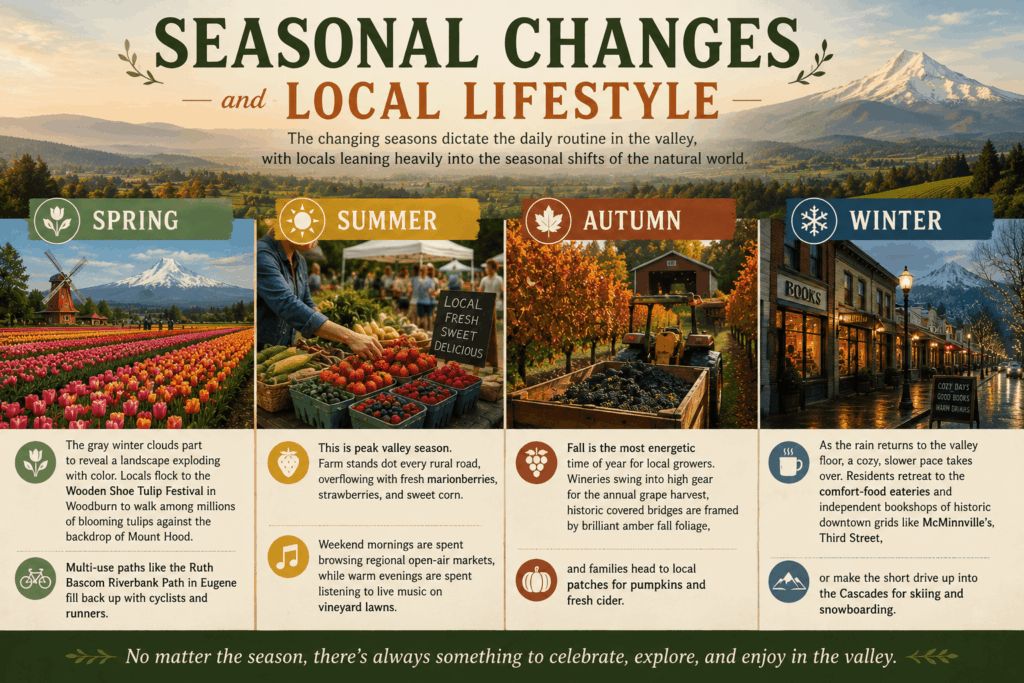
The changing seasons dictate the daily routine in the valley, with locals leaning heavily into the seasonal shifts of the natural world.
- Spring: The gray winter clouds part to reveal a landscape exploding with color. Locals flock to the Wooden Shoe Tulip Festival in Woodburn to walk among millions of blooming tulips against the backdrop of Mount Hood. Multi-use paths like the Ruth Bascom Riverbank Path in Eugene fill back up with cyclists and runners.
- Summer: This is peak valley season. Farm stands dot every rural road, overflowing with fresh marionberries, strawberries, and sweet corn. Weekend mornings are spent browsing regional open-air markets, while warm evenings are spent listening to live music on vineyard lawns.
- Autumn: Fall is the most energetic time of year for local growers. Wineries swing into high gear for the annual grape harvest, historic covered bridges are framed by brilliant amber fall foliage, and families head to local patches for pumpkins and fresh cider.
- Winter: As the rain returns to the valley floor, a cozy, slower pace takes over. Residents retreat to the comfort-food eateries and independent bookshops of historic downtown grids like McMinnville’s Third Street, or make the short drive up into the Cascades for skiing and snowboarding.
Helpful Tips for Visitors and Residents
- Pronounce it Like a Local: Nothing clears you as an outsider faster than mispronouncing the region’s name. It is Wil-AM-it, not Willa-met-tee. A handy local trick to remember is: “It’s Willamette, dammit.”
- Take the Scenic Byways: While Interstate 5 runs straight down the middle of the valley for a quick commute, the true beauty lies on the backroads. Take the 99W corridor or the Siuslaw River Highway to discover covered bridges, hidden farm stands, and quiet historic towns.
- Layer Up for Wine Tastings: Many wine tasting rooms are located in rustic barns or right on breezy hillsides. Even in the summer, mornings and evenings can get chilly quickly, so always keep a light jacket or flannel layer handy.
Seasonal Changes and Local Lifestyle
The changing seasons dictate the daily routine in the valley, with locals leaning heavily into the seasonal shifts of the natural world.
- Spring: The gray winter clouds part to reveal a landscape exploding with color. Locals flock to the Wooden Shoe Tulip Festival in Woodburn to walk among millions of blooming tulips against the backdrop of Mount Hood. Multi-use paths like the Ruth Bascom Riverbank Path in Eugene fill back up with cyclists and runners.
- Summer: This is peak valley season. Farm stands dot every rural road, overflowing with fresh marionberries, strawberries, and sweet corn. Weekend mornings are spent browsing regional open-air markets, while warm evenings are spent listening to live music on vineyard lawns.
- Autumn: Fall is the most energetic time of year for local growers. Wineries swing into high gear for the annual grape harvest, historic covered bridges are framed by brilliant amber fall foliage, and families head to local patches for pumpkins and fresh cider.
- Winter: As the rain returns to the valley floor, a cozy, slower pace takes over. Residents retreat to the comfort-food eateries and independent bookshops of historic downtown grids like McMinnville’s Third Street, or make the short drive up into the Cascades for skiing and snowboarding.
Conclusion
The Willamette Valley perfectly captures the grounded, eco-conscious, and nature-loving spirit of the Pacific Northwest. By pairing rugged natural wonder and stunning volcanic mountain backdrops with an elite culinary scene and a relaxed, welcoming community atmosphere, it offers a way of life that is both peaceful and deeply fulfilling. Whether you are sipping a perfectly balanced Pinot Noir, standing beneath a misting waterfall, or exploring a historic main street, the valley welcomes everyone with a uniquely warm and authentic Oregon charm.
Frequently Asked Questions
Where is the Willamette Valley located, and how large is it?
The Willamette Valley is an expansive, fertile basin stretching roughly 150 miles from the Columbia River in Portland all the way south to Eugene. It is geographically bounded by the rugged Oregon Coast Range to the west and the snow-capped peaks of the Cascade Mountains to the east. While it houses roughly 70% of Oregon’s population, it maintains an open, scenic, and rural environment.
What is the geological history behind the valley's incredibly rich soil?
The valley’s world-class agricultural productivity is a direct result of ancient history. During the last Ice Age, massive megafloods rushed down the Columbia River Gorge and backfilled the entire valley. This process deposited deep, mineral-rich volcanic and marine soils, turning the basin into one of the most productive agricultural zones in North America.
How is the Willamette Valley divided, and what defines the Northern Valley?
The region is a collection of distinct communities split into three primary micro-regions along the Willamette River:
-
The Northern Valley: Comprising Yamhill, Washington, and Clackamas counties, this area sits just outside the Portland metro and features historic towns like Newberg, Dundee, and McMinnville. It is universally recognized as Oregon Wine Country, boasting a high concentration of estate vineyards across the Chehalem Mountains and Dundee Hills.
-
The Mid-Valley (Marion and Linn counties)
-
The Southern Valley (Benton and Lane counties)
What are the economic and cultural focuses of the Mid-Valley and Southern Valley regions?
-
The Mid-Valley: Anchored by the state capital of Salem, this area is the flat, alluvial epicenter of Oregon’s agricultural industry. It produces the vast majority of North America’s hazelnuts, hops, berries, and turf grass.
-
The Southern Valley: Home to university towns like Corvallis (Oregon State University) and Eugene (University of Oregon), this region blends a highly independent community vibe with tech innovation, collegiate sports, and rugged outdoor recreation.
What type of climate can residents and visitors expect in the valley?
The region follows a distinct Mediterranean climate pattern that avoids extreme conditions. Winters are notoriously mild, misty, and gray. Summers, by contrast, are spectacular—delivering long, sun-drenched afternoons in the 80s with virtually zero humidity, followed by cool, crisp evening breezes.
Why is the Willamette Valley's wine industry unique compared to other commercial regions?
While the valley is globally synonymous with world-class Pinot Noir housing more than 700 wineries across 11 distinct micro-appellations (AVAs) it completely rejects a corporate feel. The vast majority of vineyards remain intimate, family-run operations where visitors can chat directly with the winemakers right on the tasting floor.
What makes Silver Falls State Park a primary natural attraction?
Located near Silverton, Silver Falls State Park is widely considered the crown jewel of the valley’s park system. It features the famous “Trail of Ten Falls,” a pristine canyon pathway where hikers can actually walk directly behind multiple roaring waterfalls cascading over ancient basalt cliffs.
How does the local lifestyle shift between Spring and Summer?
-
Spring: Locals celebrate the end of winter gray by flocking to the Wooden Shoe Tulip Festival in Woodburn to view millions of blooming tulips against the backdrop of Mount Hood. Multi-use trails, like the Ruth Bascom Riverbank Path in Eugene, fill up with runners and cyclists.
-
Summer: Lifestyle transitions to the outdoors. Rural roads line up with farm stands overflowing with fresh marionberries, strawberries, and sweet corn, while evenings are defined by open-air regional markets and live music on vineyard lawns.
What is the correct way to pronounce "Willamette," and what is the local memory trick?
Local Pronunciation Guide: Mispronouncing the valley’s name is the easiest way to stand out as an outsider. It is correctly pronounced Wil-AM-it (not Willa-met-tee).
What practical travel and clothing tips should visitors keep in mind?
-
Bypass the Interstate: While Interstate 5 offers a quick commute down the center of the valley, the true scenery lies on the backroads. Travel the 99W corridor or the Siuslaw River Highway to discover historic covered bridges and hidden farm stands.
-
Layer Up for Vineyards: Many wine-tasting rooms are located in rustic barns or exposed, breezy hillsides. Even in the peak of summer, morning and evening temperatures drop quickly, so always keep a light jacket or flannel layer handy.

0 Comments